
How much does a contractor website cost in 2026?
How much does a contractor website cost in 2026?
What does a contractor website cost in 2026?
Most remodelers pay somewhere between a few hundred dollars a year for a DIY site and about $15,000 for a custom agency build. The more useful question is what the site has to do: show finished work, cover your service area, and get quote requests from a phone. A cheap site that does none of those is not a bargain.
The ranges below are published estimates from builder, freelancer and agency guides. They are not audited prices, and they change with platform fees and labor rates.
| Option | Typical upfront cost | Typical ongoing cost | Best for | Main risk |
|---|---|---|---|---|
| DIY builder (Wix, Squarespace, GoDaddy) | Roughly $200 to $800 for the first year, all-in | About $25 to $50 a month for a business plan | Owners with time to build and update it | Hours of setup, and a generic site that is hard to keep current |
| Freelancer | Roughly $1,500 to $5,000 | Hosting, plus fees for changes | Owners who want custom work and have a clear brief | Quality and availability depend on one person |
| Agency (contractor niche) | Roughly $5,000 to $15,000 | Hosting and a monthly retainer | Companies that want strategy and ongoing work | Price, and retainers that run for years |
| Done-for-you local package | Basekey: $990 (Starter), $1,900 (Growth), $2,900 (Autopilot) | Optional care plan at $149 a month | Remodelers who want Maps and AI-answer setup included | Scope differs by package, so read what is excluded |
The Basekey prices are the figures on basekey.org as of 2026-11-01. Its page lists photography, copywriting, extra pages and the domain as not included, with the domain billed at cost.
When is a DIY builder enough?
A DIY builder is enough when you have one trade, a small service area, and the time to write your own pages and keep them current. It is the cheapest route in cash terms, but the hours are real. Setup, photo editing, and writing every page are cost even though none of it shows up on an invoice.
A DIY site becomes a problem when you need several service pages, town pages, a quote flow, and regular updates. At that point the monthly fee is often lower than the hours you would spend keeping it right, and the template look makes it harder to stand out in local results. Choose DIY only if you will actually maintain it.
What drives the price of a contractor website?
Scope drives price more than platform. Page count, custom design, quote tools, and how much copy and photography you need account for most of the gap between a $1,000 site and a $10,000 one. Platform choice matters less than people expect.
- Number of pages. Each trade, each town and each project type adds a page.
- Design work. A template with your logo costs far less than a layout built from scratch.
- Quote or booking tools. A calculator or request flow needs setup and testing.
- Content. Writing the copy and shooting the project photos can cost more than the build.
- Search and local setup. Google Business Profile links, local pages and structured data take time to do correctly.
What does a remodeler actually need on the site?
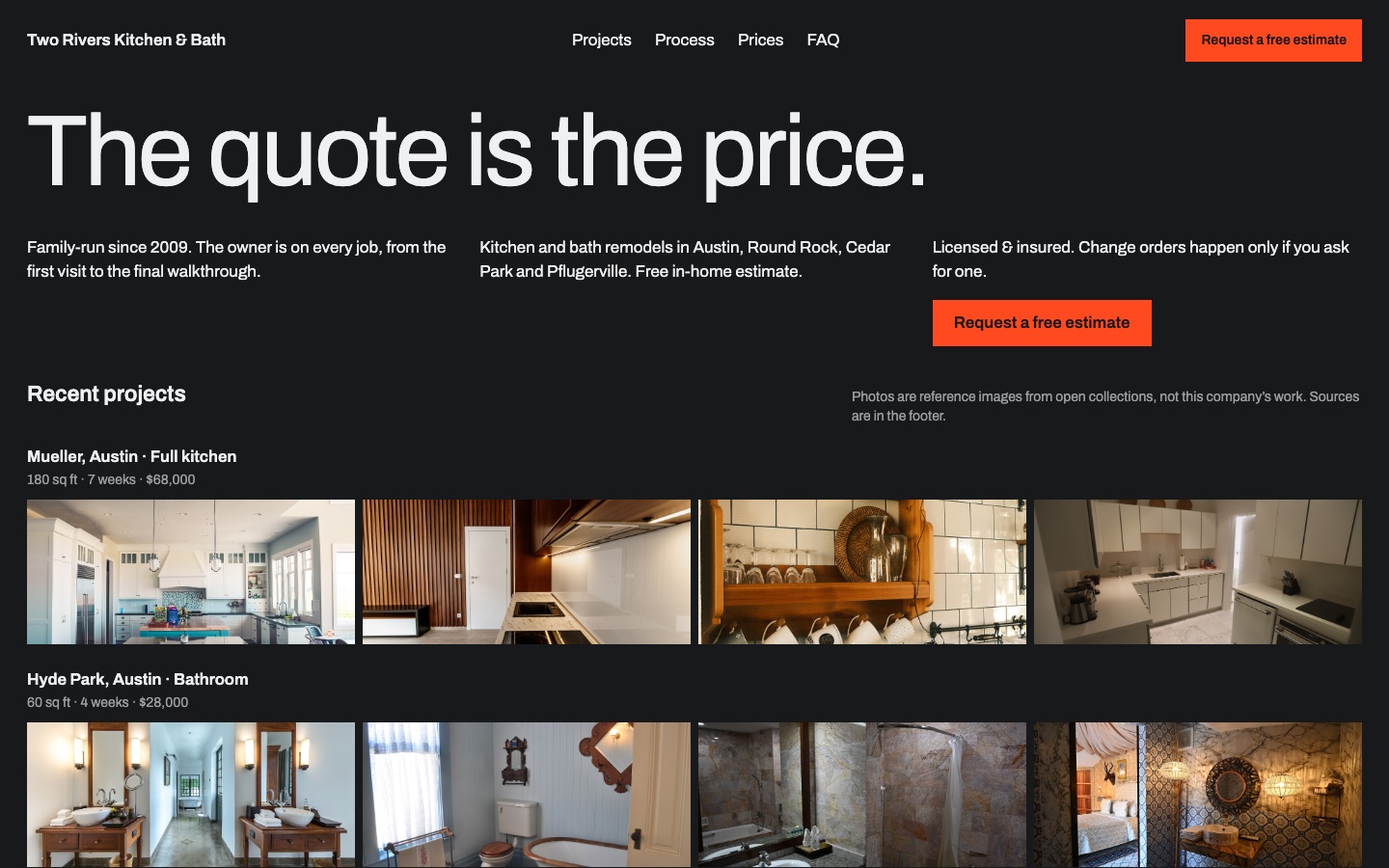
A remodeler needs a site that shows finished work, names each trade and town, and makes it easy to request a quote from a phone. Those features matter more than animation or a long list of generic pages.
Google's own guidance says there is no special markup or extra file needed to appear in AI Overviews or AI Mode. It does say that key text should be in text form, with images and videos supporting it, and that Business Profile information should stay current. Those are the basics a contractor site has to get right.
| Need | Why it matters |
|---|---|
| Service page for each trade (kitchen, bath, basement, additions) | Matches how homeowners search and gives each service a clear URL |
| Local page for each town you serve | Shows which areas you work in |
| Project gallery with captions (town, scope, timeline) | Real photos plus written detail prove the work |
| Quote request form and click-to-call button | Visitors on a phone can act in one tap |
| Business name, address and phone number matching your Google listing exactly | Consistency helps search engines and AI systems match your business to one entity |
| Reviews displayed next to the work they describe | Gives visitors and AI systems the proof they need to trust the page |
| Link to your Google Business Profile | Connects the site to your Maps listing |
What are the hidden costs?
The build price is rarely the whole bill. Domain renewal, hosting, photography, copy, edits, and ongoing care usually come on top. Ask each vendor to list them in writing.
| Cost | What to check |
|---|---|
| Domain | Renews every year at the registrar. Basekey bills it at cost. |
| Hosting | Often included with a builder. A separate hosting bill can apply to custom builds. |
| Photography | Usually not included. Phone photos of real jobs can work if they are sharp and well captioned. |
| Copywriting | Often not included. Generic copy is the most common reason a site reads like every other one. |
| Extra pages | Each added service or town page may be billed separately. |
| Care plan | Basekey's optional care plan is $149 a month and covers monthly checks, content updates and a quote-request count each month. |
| Post-launch changes | Freelancers and agencies often bill changes by the hour. |
Monthly fees add up. One builder guide estimates ongoing costs of $50 to $300 a month for hosting, maintenance and updates, and warns that a rented site can cost more over ten years than one you own.

How do you compare two contractor website quotes?
Put every quote on the same list: pages included, design work, photography, copy, domain, hosting, edits, and the monthly fee. Two quotes that look $500 apart can differ by $3,000 once the exclusions are added. For example, a $900 quote that leaves out photos, copy and extra town pages can cost more in the end than a $1,900 quote that includes them. The first number is only the starting point. Ask who owns the files and the domain if you leave, and whether you can export the content.
If you want to see what a site could look like for your company before you commit to anything, Basekey offers a free mockup at basekey.org.
Sources
Accessed 2026-11-01.
- Basekey pricing and inclusions: https://basekey.org (prices and exclusions as stated on the page).
- Google, "AI features and your website" (no special requirements for AI Overviews or AI Mode; text content and Business Profile accuracy): https://developers.google.com/search/docs/appearance/ai-features
- Contractor website cost estimates, DIY and freelancer ranges: https://skillmammoth.com/blog/how-much-should-a-contractor-website-cost (partially verified; vendor estimate)
- Contractor website cost estimates, agency ranges: https://www.routeless.io/blog/contractor-website-cost (partially verified; vendor estimate)
- Small business website cost estimates, ongoing hosting and maintenance: https://lonelyentrepreneur.com/how-much-does-it-cost-to-build-a-website-for-a-small-business/ (partially verified; vendor estimate)
- Contractor website cost estimates, cross-check: https://conductiveweb.com/guides/contractor-website-cost (partially verified; vendor estimate)
Note on the ranges: no independent, audited price survey for contractor websites was found. The DIY, freelancer and agency ranges are estimates from vendor guides and are marked as such.
See a mockup with your business name
Basekey builds a one-page site for renovation contractors. You see a mockup with your business name before you pay anything.